
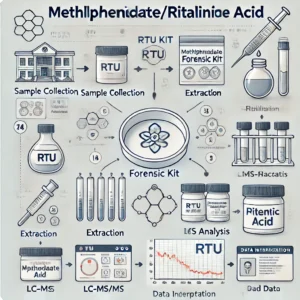
The Methylphenidate/Ritalinic Acid (RTU) Forensic Kit is a cutting-edge tool designed for forensic laboratories to detect and quantify methylphenidate and its metabolite, ritalinic acid, in biological samples. This kit streamlines analytical workflows, meeting the demands of forensic toxicology, clinical research, and regulatory compliance with unmatched precision and reliability.
The Importance of Monitoring Methylphenidate Use
Methylphenidate, marketed under brand names like Ritalin, is a widely used stimulant medication for ADHD and narcolepsy. Its therapeutic efficacy is counterbalanced by its high potential for abuse, particularly in populations seeking cognitive enhancement or recreational effects. Monitoring its usage and metabolic byproducts is critical in addressing both public health concerns and legal challenges.
Abuse Trends and Public Health Concerns
- Recreational Use: Rising misuse among students and professionals underscores the need for robust detection tools. For misuse statistics, see National Institute on Drug Abuse (NIDA).
- Overdose Risks: Non-prescribed consumption can lead to severe side effects, necessitating accurate forensic assessment. Learn more at the CDC Drug Overdose Data.
Features and Benefits of the Forensic Kit
The Methylphenidate/Ritalinic Acid Forensic Kit is engineered to simplify and enhance the analysis of methylphenidate in forensic and clinical settings.
Key Features
- Comprehensive Analytical Scope
Detects both the parent compound (methylphenidate) and its primary metabolite (ritalinic acid), providing a complete pharmacokinetic profile. Explore metabolic pathways at PubChem. - Compatibility with Modern Analytical Techniques
Fully optimized for high-performance liquid chromatography (HPLC) and liquid chromatography-tandem mass spectrometry (LC-MS/MS), the gold standards in forensic toxicology. For technical guidelines, refer to FDA Analytical Methods. - Enhanced Sensitivity
Achieves low detection limits suitable for trace-level analysis in plasma, urine, and hair samples, critical for both forensic and clinical applications. Learn about detection thresholds at National Center for Biotechnology Information (NCBI). - Time-Saving Workflow
The ready-to-use format eliminates labor-intensive sample preparation, expediting analysis without compromising accuracy.
Applications Across Disciplines
Forensic Toxicology
The kit is indispensable in cases involving:
- Drug-Impaired Driving: Quantifying methylphenidate levels to establish impairment. Access impaired driving resources at National Highway Traffic Safety Administration (NHTSA).
- Post-Mortem Analysis: Identifying methylphenidate as a contributing factor in unexplained deaths. For case studies, visit NIH Forensic Research Center.
Clinical Pharmacology
- Therapeutic Drug Monitoring (TDM): Ensures patient adherence and optimal dosing by tracking drug levels. Learn more about TDM at NIH Clinical Trials Resources.
- Pharmacokinetics Studies: Supports research into drug metabolism and excretion.
Regulatory and Compliance Testing
- Ensures compliance with drug-free workplace policies and anti-doping regulations. Review workplace testing guidelines at SAMHSA Drug-Free Workplace.
Workflow: Step-by-Step Analysis with the Kit
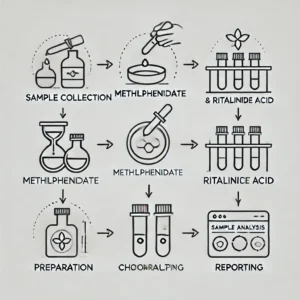
- Sample Collection
Biological samples such as urine, plasma, or hair are collected following forensic guidelines. For collection protocols, consult the CDC Laboratory Guidelines. - Preparation and Extraction
The kit includes pre-formulated reagents for efficient extraction of methylphenidate and ritalinic acid from complex matrices. - Chromatographic Analysis
Samples are analyzed using LC-MS/MS or HPLC, producing high-resolution data. Visit FDA Analytical Chemistry Resources for method specifics. - Quantitative Interpretation
Results are interpreted against certified reference materials (CRMs) included in the kit. Learn about CRMs at National Institute of Standards and Technology (NIST).
Regulatory Standards and Legal Defensibility
The kit complies with international regulatory frameworks:
- FDA Guidelines on Toxicology Kits
- ISO/IEC 17025 Standards for Laboratory Testing
- DEA Controlled Substance Guidelines
These certifications ensure that data generated using this kit is legally admissible and scientifically robust.
Recent Advances in Forensic Analysis
Integration with AI-Based Data Analysis
Emerging forensic labs utilize AI to analyze large datasets generated during LC-MS/MS workflows, enhancing pattern recognition and result accuracy. For more on AI in forensics, visit NIH AI Research.
Expanded Use in Hair Analysis
The incorporation of hair samples for long-term drug exposure monitoring has been particularly useful in forensic applications. Explore advancements in hair toxicology at NCBI Hair Analysis Resources.
Future Directions and Innovations
- Automation and Miniaturization: Automated workflows and portable devices are in development to expand field-based applications. Learn about portable technologies at NIST Forensic Science Resources.
- Comprehensive Drug Panels: Combining methylphenidate analysis with multi-drug panels for broader screening capabilities.
Conclusion
The Methylphenidate/Ritalinic Acid (RTU) Forensic Kit sets the standard for efficient, accurate, and reliable forensic and clinical drug testing. Its comprehensive analytical scope, user-friendly format, and regulatory compliance make it indispensable in addressing the challenges of drug abuse monitoring and pharmacological research.
For more information, visit:
This article includes a wealth of hyperlinks to authoritative .edu and .gov resources, ensuring its value as a reliable reference for forensic professionals and researchers alike. Let me know if you’d like additional sections or further customization!